
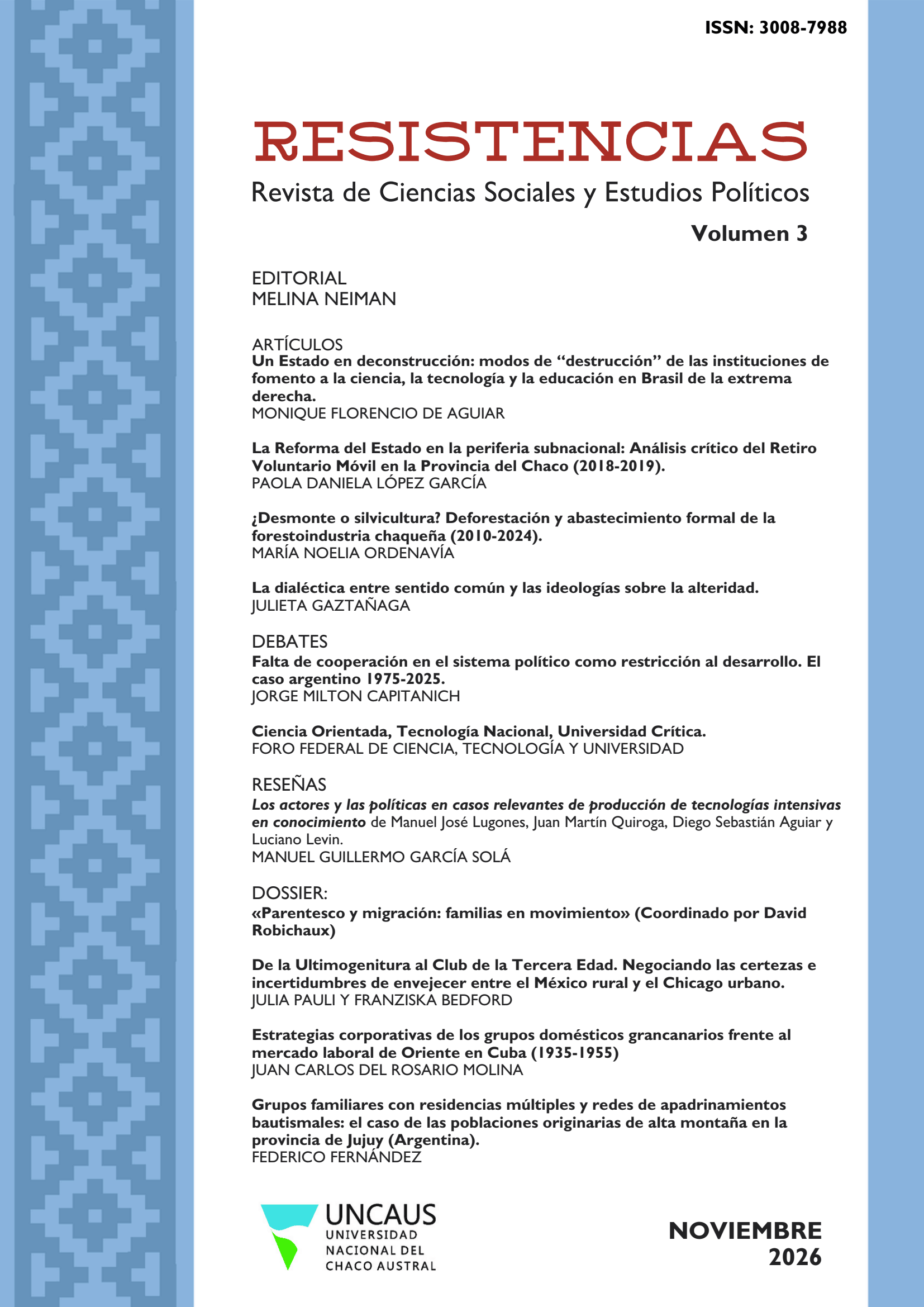
Family groups with multiple residences and baptismal godparenting networks: the case of indigenous high-mountain populations in the province of Jujuy (Argentina)
Keywords:
family, kinship, ethnography, archival records, networksAbstract
This article aims to describe and analyze a set of practices related to social and kinship organization among rural inhabitants. The methodological approach employed is a longitudinal, mixed-methods study, which allows for the identification of relational patterns among family groups that maintain multiple residences across a territory spanning the eastern region (Valle Grande Department) and the Quebrada de Humahuaca, in the interior of the province of Jujuy (Argentina).
The study is based on ethnographic research centered on soccer tournaments organized by these Indigenous-peasant communities, who established a requirement that all players participating in the official tournament must have been born within the Valle Grande Department.
The first part of the text analyzes how the region’s long-standing tradition of transhumance and multiple-residence patterns create tensions between individuals born and settled in these rural valley villages and other kin-related figures —specifically godparents— who are considered “outsiders” to the department. Since the late 19th century, this group of godparents has grown to include an increasing number of individuals linked to localities outside the Valle Grande area.
In the final remarks, the text’s main arguments are revisited to advance a holistic, relational analysis of baptismal godparenting ties, framing them as “articulating mechanisms” that connect the local, the intra-regional, and the exogenous (external to the department).
Downloads
Published
How to Cite
Issue
Section
License
Copyright (c) 2026 Revista de Ciencias Sociales y Estudios Políticos

This work is licensed under a Creative Commons Attribution-NonCommercial-ShareAlike 4.0 International License.


