
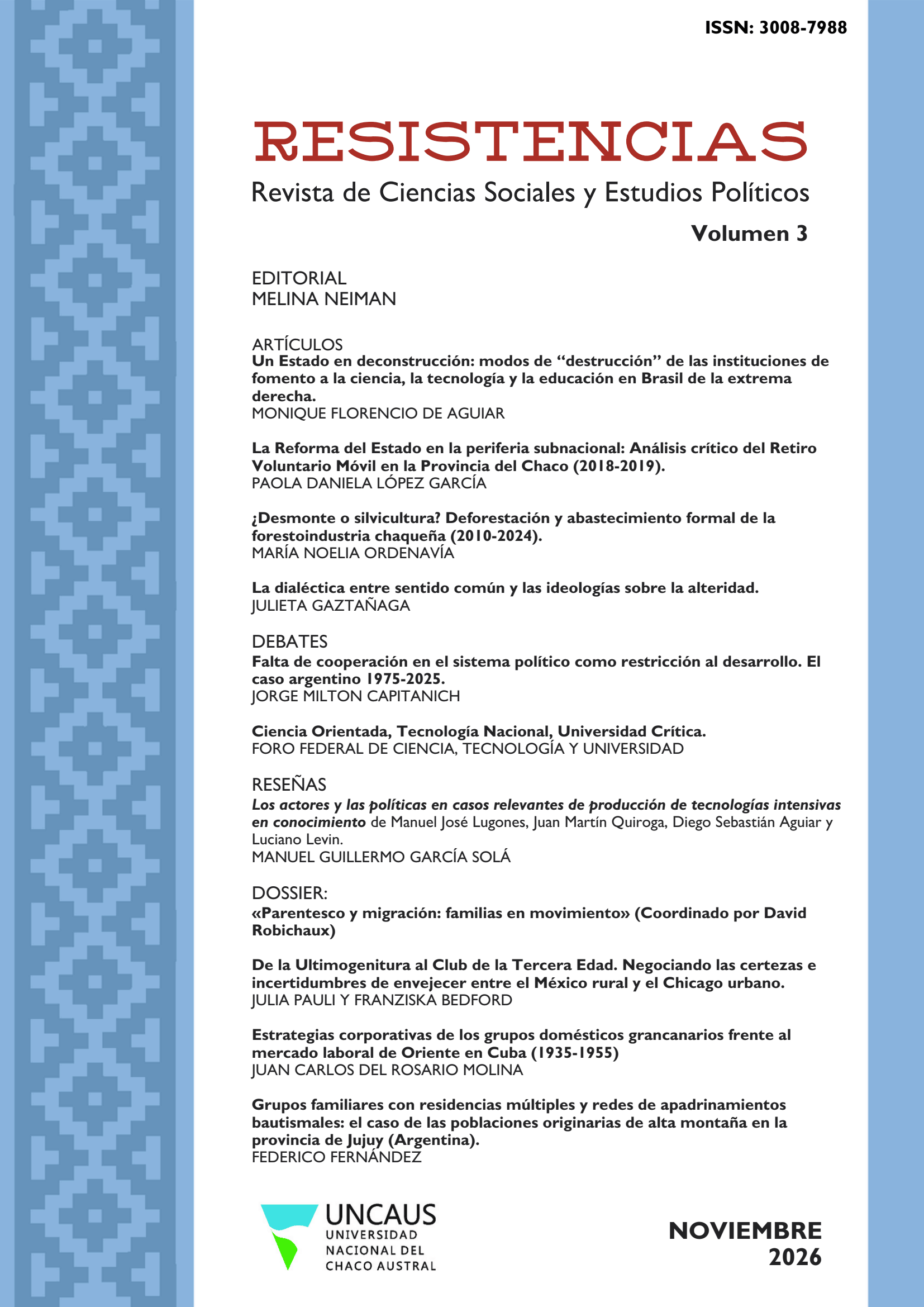
The State Reform in the Subnational Periphery: Critical Analysis of the Mobile Voluntary Retirement Scheme in the Province of Chaco (2018–2019)
Keywords:
state reform, new public management, adverse selection, public employment, state capacities, voluntary retirement, subnational government, ChacoAbstract
This article analyses the Voluntary Mobile Retirement scheme of Chaco (2018–2019 period) under the New Public Management paradigm and conditioned by the agreement with the International Monetary Fund and the Fiscal Responsibility Regime, aiming to streamline the state payroll in a province with a peripheral economy and high dependence on public employment.
The research is structured around the question: what institutional design factors and structural mechanisms explain the lack of effectiveness of Law N° 2871-H in achieving its quantitative personnel reduction targets?
Using a mixed-methods (qualitative-quantitative) design with an explanatory scope, the study analysed regulations, statements by authorities, and a systematization of 608 retirement decrees signed by the provincial Executive, alongside the evolution of public sector employment.
The empirical findings confirm the research hypothesis: the policy exhibited a sharp adverse selection bias resulting from a poorly calibrated linear incentive structure, lacking selectivity filters and prior functional evaluations. The effectiveness level reached only 8.68% of the original target, compounded by the departure of the most highly trained personnel, which triggered a brain drain in critical areas such as the Ministry of Public Health —accounting for 55.75% of total retirements and 69.56% of departing professionals—.
Finally, the study demonstrates that the personnel contraction did not yield significant fiscal savings, and the COVID-19 pandemic subsequently required new hires to fill those vacancies, worsening bureaucratic distortion and eroding the institutional capacities of the subnational State.
Downloads
Published
How to Cite
Issue
Section
License
Copyright (c) 2026 Revista de Ciencias Sociales y Estudios Políticos

This work is licensed under a Creative Commons Attribution-NonCommercial-ShareAlike 4.0 International License.


